Maren misses her reunion with her mother in Edgartown
Bones & AllMaren misses her reunion with her mother in Edgartown by finding Janelle at her grandparents’ home and watching from outside instead of making herself known. The encounter gives Maren a new understanding of her mother’s pain, but not the reconciliation she had hoped to make possible. She leaves without speaking to Janelle, carrying a locket as a keepsake and directing her journey away from the house where she had found her.
The Journey to Edgartown
Maren begins with a mistaken understanding of the money her mother gave her. After reading her birth certificate and discovering the name Francis Yearly in the space for her father, she realizes that Janelle expected her to travel to Sandhorn, Minnesota, find him, and leave her mother behind. The possibility of meeting her father does not feel like a solution: Maren wants instead to make things right with Janelle. She has also learned that her mother has gone to her own parents, and decides to follow her there, using the hundred dollars to make the trip.
Before leaving, Maren eats what remains in the refrigerator, showers, and packs the belongings she can fit into an old army rucksack marked SHIELDS and U.S. ARMY. She chooses books carefully because the pack will grow heavier as she carries it, taking her birthday book and her two-volume Alice set along with a glow-in-the-dark compass and tortoiseshell eyeglasses. The limited luggage makes the journey concrete: she is leaving with what she can bear, without knowing what she will say when she reaches her mother.
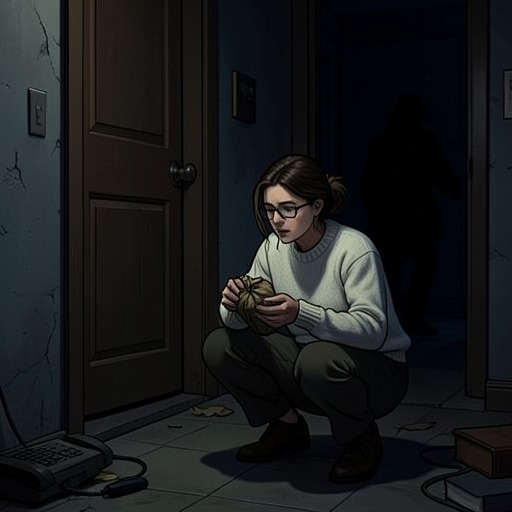
Maren reaches Edgartown and asks for directions at McDonald’s. By the time she arrives in her grandparents’ neighborhood, it is almost dark. Their split-level house sits among homes and yards closely bounded by similar properties. Seeing the family car in the driveway, behind a dark blue Cadillac she takes to be her grandfather’s, makes the household feel immediately present but still inaccessible. She waits for darkness, circles the block, and climbs over a neighbor’s fence. She would rather be caught by someone who does not know her than reveal herself to the family she has come to see.
Watching Through the Window
From beside the fence, Maren works out that the kitchen is at the back of the house and watches through its large window. The view reverses the usual promise of a picture window: with the room lit and the yard dark, the family at dinner appears to her like a scene playing on a screen. Maren is close enough to see her mother, but the glass and her concealment keep the two of them separated.
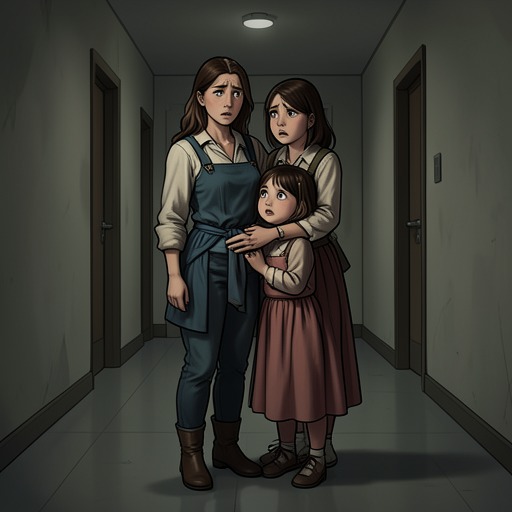
Janelle brings the salad bowl to the table, where her father pours her a glass of wine. Maren cannot see either grandparent clearly: her grandfather’s back faces the window, and her grandmother sits opposite it. But she sees her mother pushing food around her plate, answering in single words, dropping her fork, and hiding her face in her hands. Her grandmother rises and holds her; Janelle clings to her and cries. Maren concludes that her mother has probably told her parents everything. The scene supplies what she could not learn from watching Janelle alone: her mother is not simply refusing her daughter, but is herself visibly overwhelmed and in need of comfort.
That recognition changes how Maren understands familiar signs of distress. She had seen Janelle lock herself in the bathroom, empty wine bottles lined up along the kitchen counter, and heard her crying through the wall. Maren had felt sorry for her and wished she could be different, but had not understood what her mother was going through. Watching Janelle break down and be held by her own mother, Maren begins to understand. The insight arrives through observation rather than conversation; the reunion remains one-sided.
Leaving Without a Reunion
After Janelle has worn herself out crying, her mother gives her a tissue. Maren’s grandfather lights a cigarette and offers the pack to Janelle. Her mother accepts, startling Maren because she has never known her to smoke. Later, the grandmother clears the table and washes the dishes while Janelle and her father sit smoking in silence. The grandmother then puts an arm around Janelle’s shoulders and leads her from the room. When the grandfather turns out the kitchen light, Maren climbs back over the fence and leaves the neighborhood without announcing herself.
She walks along a busy road of shops already closed for the night and finds no place to buy even a slice of pizza. At the back of a strip mall, she searches for food near a Dumpster and instead finds an unlocked Cadillac. Its scattered newspapers, empty soda cans, damaged upholstery, and unpleasant smell make it an unwelcoming refuge, but Maren cleans the back seat as best she can, gets inside, and locks the doors. Her route to her mother has led not to shelter with family but to a night alone in an abandoned-looking car.
The next morning, Maren takes a cream-and-pink enamel locket from the mantel. She knows the jewelry belongs to Janelle’s niece, but needs something to remember Janelle by. The locket holds a small photograph of Mr. Harmon; its image is a keepsake, not a substitute for the conversation Maren never has with her mother. A few minutes later, she boards a local bus and recognizes that she is traveling in the opposite direction from the Shieldses’ house. She understands this departure as final: she expects never to see Janelle again, not even from outside a window.
Significance of the Missed Encounter
The episode turns Maren’s search for reconciliation into a private act of witnessing. She arrives intending to reach her mother, but the sight of Janelle receiving comfort from her parents both deepens Maren’s sympathy and makes her retreat. Instead of asking what Janelle has said or entering the house, she interprets the scene from the dark, then leaves when the lights go out. The emotional change is real, but it does not repair their separation.
The window and the fence give the missed reunion its shape: Maren can see her mother clearly, yet remains outside the family scene. Her later choice of the locket preserves the same tension between closeness and distance. She takes an object associated with the house while accepting that she will not return to it. On the bus, she turns away from the Shieldses’ home and toward the next leg of her journey, carrying both a sharper understanding of Janelle and the unresolved absence of any words between them.